


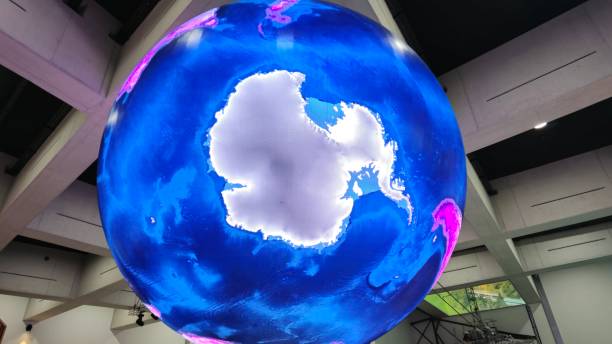
Since the dawn of civilization, the celestial sphere has served as the ultimate canvas for human imagination. Our ancestors looked at the dome of the night sky and saw gods, heroes, and mythological beasts traced in light. Today, as urban light pollution veils the natural Milky Way, a new medium is emerging to reclaim that ancient sense of wonder.
The LED spherical display screen is the digital successor to the traditional planetarium. By inheriting the primal impulse of the “celestial dome,” these modular marvels of engineering are transforming city squares, science museums, and commercial atriums into modern astronomical gateways. They do more than just show data; they re-sculpt the urban landscape with digital pixels, creating a “Liquid Universe” that connects our ancient worship of the stars with the digital aesthetics of the future. This article explores how the modular LED sphere is redefining public art and astronomical education, serving as a high-tech vehicle for the legends of the stars.
1. The Geometry of the Universe: Why the Sphere is the Perfect Canvas
The sphere is nature’s most fundamental shape. From the smallest atom to the largest planet, the curve is the language of the cosmos. In the context of display technology, the transition from “flat” to “spherical” represents a profound leap in how humans consume visual information.
Breaking the “Flat Screen” Limitation
Traditional flat screens act as a window—you look at them. An LED spherical display screen, however, is an object that occupies space in 360°. It doesn’t just show an image of the earth or a star; it becomes the earth or the star.
-
Omnidirectional Perspective: In a public square or a commercial lobby, there is no “best seat.” Whether a viewer is standing below, beside, or above the sphere, the celestial narrative remains coherent and immersive.
-
The Psychological “Dome” Effect: Humans have a natural psychological affinity for curved surfaces. A sphere creates a sense of enclosure and “wholeness” that flat surfaces lack, making it the ideal medium for representing the vast, enveloping nature of the universe.
2. Engineering the Stars: The Modular Logic of the Digital Globe
Creating a perfect sphere out of thousands of flat LED modules is one of the most significant challenges in modern display engineering. It requires a marriage of structural mathematics and high-precision manufacturing.
The “Polygon” Architecture
To create a seamless 360° surface, engineers utilize specialized triangular or trapezoidal LED modules. Like the facets of a diamond, these modules are assembled onto a custom-engineered steel skeleton.
-
Seamless Splicing: Advanced calibration technology ensures that the “seams” between modules are invisible to the human eye. This allows for a perfectly continuous flow of light, which is essential when simulating the fluid movement of nebulae or the rotation of a planet.
-
Uniform Pixel Density: On a flat screen, pixels are easy to align. On a sphere, maintaining a consistent pixel pitch (the distance between pixels) across the entire curve is critical. This ensures that a constellation doesn’t look “stretched” at the equator or “compressed” at the poles.
Heat Dissipation and Structural Integrity
A sphere is a closed system, which makes heat management a priority. Modern modular LED spheres utilize “natural convection” designs and high-efficiency power supplies to ensure that the “digital sun” doesn’t overheat. This engineering allows these globes to run 24/7 in high-traffic public spaces.
3. The Modern Planetarium: Education Meets Immersive Art
Traditional planetariums used optical projectors to cast light onto a static dome. While beautiful, these systems were limited in brightness and interactivity. The LED spherical display screen represents a “Passive-to-Active” revolution in astronomical education.
High-Brightness Astronomy
In a brightly lit science museum or a sunlit shopping mall, traditional projectors fail. LED spheres, however, possess self-emissive power. They can display the intense solar flares of the sun or the vibrant purples of the Orion Nebula, even in broad daylight.
-
Real-Time Data Visualization: Modern LED globes can be connected to NASA or ESA satellites. They can show real-time weather patterns on Earth, live solar activity, or the current position of the International Space Station (ISS), turning a static sculpture into a living scientific instrument.
The Abstract Visual Poem
Beyond education, the LED sphere is a tool for “Digital Poetics.” An artist can use the sphere to depict a “dreamscape”—a constellation that morphs into a school of bioluminescent fish, or a galaxy that pulses in rhythm with ambient music. It becomes a “Public Heartbeat,” a glowing icon that provides a moment of transcendental beauty in the middle of a bustling city.
4. Strategic Value: Why the Sphere is the Landmark of the Future
For developers and architects, the installation of an LED spherical display screen is a strategic move to define a space as a “Future Landmark.”
-
Unrivaled “Stop-and-Stare” Power: In an age of distraction, the unique form factor of a glowing, 360° globe is an irresistible magnet for foot traffic. It is a “social media landmark” that encourages visitors to take photos and share their experience online.
-
Versatile Branding: A sphere is the ultimate branding tool. It can be the Earth for an environmental conference, a giant basketball for a sports brand, or a shimmering pearl for a luxury jewelry launch. This versatility ensures a high Return on Investment for commercial venues.
-
Urban Revitalization: Large outdoor LED spheres can transform “dead” urban spaces into vibrant cultural hubs. By broadcasting “Digital Astronomy,” they offer a form of public entertainment that is educational, non-intrusive, and profoundly beautiful.
5. The Technical Foundation: How to Choose a Spherical Display
When selecting a modular LED globe, the “poetry” of the stars must be supported by the “prose” of technical specifications.
| Feature | Requirement for “Celestial Clarity” | Benefit for the Venue |
| Pixel Pitch | P2.5 to P4 (for indoor spheres) | Ensures crisp star-points even from a close distance. |
| Grayscale | 14-bit to 16-bit | Provides smooth gradients in deep-space nebulae. |
| Refresh Rate | ≥ 3840Hz | Prevents flickering on camera (Essential for viral marketing). |
| Control System | Synchronous/Asynchronous | Allows for live streaming and scheduled content. |
| Maintenance | Front-access modules | Allows for quick repairs without dismantling the globe. |
6. Conclusion: The Return of the Stars
For millennia, the stars have been our map, our calendar, and our library of myths. While we may have built cities that outshine the sky, our souls still crave the perspective that only the cosmos can provide.
The LED spherical display screen is not just a piece of hardware; it is a cultural bridge. It brings the “Great Beyond” into the “Here and Now.” By weaving together modular LED technology and astronomical wonder, we are not just lighting up a room—we are rewriting the legends of the constellations for a new generation. We are giving the city back its stars.
