


In the world of creative architectural displays, Die inner arc LED displays represent one of the most visually arresting formats. Whether they are forming a 360-degree immersive tunnel or a sweeping concave backdrop for a flagship store, these curved structures redefine spatial dynamics. Jedoch, as the scale of these installations grows and the curvature becomes more extreme, a significant engineering challenge emerges: the conflict between self-weight and structural rigidity.
Traditionally, achieving a perfect, gapless curve required heavy steel sub-frames and thick aluminum alloy cabinets. This weight often exceeded the load-bearing capacity of modern interior walls, particularly in renovation projects of older buildings. To solve this, advanced engineering has turned to aerospace-grade materials and modular logic. By utilizing carbon fiber composite backplanes Und lightweight modular frames, designers can finally “lighten the load” der Kurve, achieving a quantum leap in installation flexibility without sacrificing micron-level precision.
1. Der “Heavy Curve” Dilemma: Why Weight Matters
For a standard flat LED screen, gravity acts uniformly along the vertical plane. Jedoch, for an inner arc LED display, the physics changes. Large-scale concave structures create a “cantilever effect,” where the center of gravity shifts forward, putting immense torque on the mounting points.
The Burden of Traditional Steel
In the past, to ensure that the arc did not “sag” or warp over time, engineers relied on massive steel armatures. This added thousands of kilograms to a building’s facade or ceiling.
-
Renovation Barriers: Many premium retail spaces or museums are located in heritage buildings where the structural integrity cannot support traditional heavy LED systems.
-
Installation Complexity: Heavy screens require specialized cranes and larger installation crews, which drives up the Total Cost of Ownership (Gesamtbetriebskosten).
The Rigidity Requirement
Despite the need for lightness, the screen cannot be “soft.” If the backplane flexes even by a millimeter, the seams between the LED modules will open up, creating visible black lines that ruin the immersive experience. daher, the goal is to achieve “Low Mass, High Modulus”—a structure that is incredibly light yet resists bending under its own weight.
2. Carbon Fiber Composite: The Aerospace Solution
To solve the weight-rigidity paradox, advanced inner arc LED displays now incorporate carbon fiber composite backplates. Originally reserved for aerospace and Formula 1 racing, carbon fiber offers a strength-to-weight ratio that far exceeds aluminum or steel.
The Science of the Material
Carbon fiber is composed of crystalline filaments of carbon that are woven together and set in a resin matrix.
-
Weight Reduction: A carbon fiber LED cabinet can weigh up to 50% less than a traditional die-cast aluminum cabinet of the same size.
-
Thermal Stability: Unlike metals, carbon fiber has a near-zero coefficient of thermal expansion. This means the arc remains perfectly precise even as the LED modules generate heat, preventing the “warping” that can occur with temperature fluctuations.
Precision Molding for Curves
Because carbon fiber is a composite, engineers can mold it into specific concave shapes during the curing process. This allows for a “monocoque” structure where the backplane itself follows the desired arc radius, providing a naturally rigid foundation for the LED modules to sit upon.
3. Modular Lightweight Frames: Topology and Efficiency
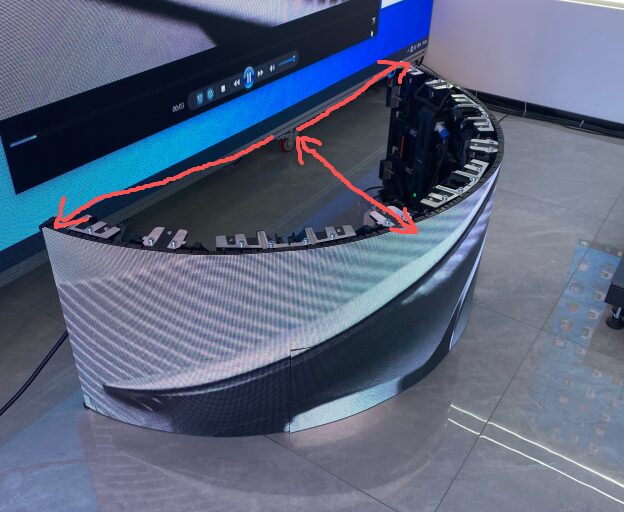
Beyond the material of the cabinet, the secondary frame—the “skeleton” that holds the cabinets together—has undergone a revolution in Topology Optimization.
Strategic Load Paths
Instead of using uniform solid beams, modern modular frames utilize “Open-Web” oder “Lattice” designs. By using Finite Element Analysis (FEA), designers identify the exact paths where stress travels through the arc.
-
Action: Engineers remove material from low-stress areas and reinforce high-stress nodes.
-
Ergebnis: This creates a modular frame that provides the necessary stiffness to maintain a perfect 120-degree or 180-degree curve while significantly reducing the overall mass of the skeleton.
Modular Connectivity
The frame utilizes a “Click-and-Lock” modular logic. This allows for rapid assembly on-site. Because the frames are light, a two-person team can often handle the installation of a single section without heavy lifting machinery, making it ideal for the confined, complex spaces found in luxury boutiques or high-end showrooms.
4. Achieving the “Perfect Curve” with Micron Precision
The true test of a lightweight inner arc LED display is its visual seamlessness. Even a slight misalignment in a concave screen is magnified by the way light converges in the center.
-
Self-Leveling Hubs: Advanced frames feature adjustable “schwebend” connectors. These allow installers to fine-tune the alignment of each module in the X, Y, and Z axes to compensate for uneven wall surfaces.
-
Mechanical Memory: Once locked into place, the carbon fiber backplane’s inherent rigidity ensures that the screen maintains its “Mechanical Memory.” It will not settle or shift over months of operation, ensuring that the “Liquid Narrative” of the content remains undisturbed.
5. Broadening the Application Boundaries
By reducing the structural requirements for installation, lightweight inner arc technology opens up new possibilities for architects.
Suspended Domes and Flying Arcs
Because the weight is so low, these screens can be suspended from ceiling cables to create “Floating Inner Arcs.” In an airport terminal or a large hotel lobby, a suspended concave screen can provide a 360-degree information hub that doesn’t obstruct the floor space, creating a sense of “digital transparency.”
Rapid Pop-Up Experiences
In the world of luxury product launches or auto shows, the ability to assemble a massive inner arc screen in a single night is a major competitive advantage. The lightweight modularity allows brands to bring a permanent-quality “Immersive Tunnel” to temporary venues with ease.
6. Abschluss: The Future is Light and Strong
The evolution of the inner arc LED displays from a heavy, industrial installation to a lightweight, aerospace-inspired design marks a turning point in media architecture. By embracing carbon fiber composites and optimized modular frames, we have successfully “de-weighted” the curve.
This technical achievement goes beyond easier installation. It allows digital experiences to expand into previously impossible spaces. Applications include high-altitude observatories and historical renovations. It also adapts to complex curved glass facades. Balanced weight and rigidity protect architectural safety. Visual performance remains seamless and flawless. Perfect immersive curves rely on hidden material strength.
