


Why Pixel Pitch Drives Outdoor Visibility
Outdoor LED screens must perform under one of the most difficult lighting conditions on earth—direct sunlight. Yet many buyers still evaluate displays only by brightness levels or cabinet build. While those factors matter, pixel pitch remains the element that most influences real-world visibility. Pixel pitch controls clarity, defines viewing comfort, and shapes the long-term usability of display LED visibili alla luce del giorno.
Across global markets, buyers demand screens that stay readable during noon hours and remain stable under harsh weather. Così, pixel pitch selection has become a strategic decision rather than a simple technical preference. When project teams understand the role of pixel pitch, they can protect budgets, improve audience engagement, and extend the operating life of outdoor LED installations.
This article explores the engineering principles behind pixel pitch and explains how it interacts with brightness, contrasto, progettazione modulare, and content strategy. It also outlines best practices that professional buyers follow when building next-generation daylight-visible LED displays.
Understanding Pixel Pitch and Its Optical Impact
Pixel pitch describes the distance between LED pixels on a screen. Although it seems like a single numeric specification, its effects reach far deeper. It determines how light blends, how colors appear from a distance, and how images hold their structure under intense daylight.
UN smaller pixel pitch places LEDs closer together, allowing the viewer’s eye to merge points of light into smooth images. This blending effect improves clarity at shorter distances. Tuttavia, outdoor applications introduce different viewing patterns. Crowds watch from distances that vary widely, and screens must remain visible even when sunlight reduces contrast. Larger pixel pitch models sometimes offer stronger durability and better heat performance, which is why outdoor LED screens use pitch values that differ from indoor installations.
Because daylight interacts with LED modules differently from artificial light, pixel pitch must support not only resolution but also luminance control. When pixels sit too far apart, sunlight can wash out dark areas and create visual gaps. When they sit too close, the system may generate unnecessary heat and increase power consumption. Perciò, the correct pixel pitch must balance clarity, luminosità, and efficiency.

How Pixel Density Shapes Daylight Visibility
Sunlight reduces the eye’s ability to differentiate detail. Così, outdoor LED displays must maintain visual integrity even as ambient light reaches peak intensity. Pixel density directly influences this capability because it shapes the stability of edges and the depth of color transitions.
With higher pixel density, displays produce sharper content that withstands glare. The increased number of LEDs also strengthens brightness uniformity, which prevents patchy areas when sunlight hits the screen at an angle. Tuttavia, higher density increases cost, weight, and power load. Outdoor installations require additional thermal control to protect LEDs, and dense modules generate more heat.
Perciò, outdoor projects must match pixel pitch to actual viewing conditions instead of assuming that the smallest pitch provides the best performance. When the crowd watches from 30 metri di distanza, a very small pitch offers no visible benefit and instead increases operating costs. Buyers who understand these relationships make more rational decisions, especially when building large-format daylight-visible LED displays.
The Interaction Between Pixel Pitch and High Brightness
Brightness remains one of the central performance indicators for outdoor LED systems, yet it works in tandem with pixel pitch rather than independently. Even the brightest LED display loses readability when pixel spacing becomes too wide for its intended viewing distance.
High-brightness LED displays must maintain stable luminance across every module. When pixel pitch is optimized, brightness does not need to reach extreme levels to achieve daylight visibility. This reduces power consumption, improves thermal stability, and extends LED lifespan.
Al contrario, when pixel pitch is too large, brightness must rise significantly to compensate for visual loss. This leads to heat buildup and energy waste. Di conseguenza, professional integrators rely on balanced pitch-brightness configurations that produce consistent visibility without overspending on power.
How Pixel Pitch Relates to Contrast in Daylight
While brightness counters sunlight, contrast preserves detail. Pixel pitch plays a critical role because it influences how shadows and color boundaries appear when the environment floods the screen with white light.
Smaller pixel pitch reduces the unused surface area between LEDs. This limits the amount of reflective background exposed to sunlight. With less reflection, black levels appear deeper, which increases perceived contrast.
Improved contrast keeps text readable and ensures that videos retain dynamic range. Pubblicità esterna, transportation signage, stadium screens, and architectural façades all rely on this effect. When pixel pitch aligns with environmental lighting conditions, the display maintains a clear visual hierarchy even during bright noon hours.
Pixel Pitch and Color Accuracy Under Sunlight
Color accuracy often receives less attention in outdoor LED projects because teams prioritize brightness. Yet pixel pitch strongly affects color consistency.
When the pitch is too large, viewers can detect pixel separation at closer distances. This creates color fragmentation, especially in gradients and low-saturation zones. Under sunlight, this fragmentation becomes more visible and reduces the professional appearance of the display. Smaller pixel pitch improves color blending, increasing realism and enhancing brand presentation.
Perciò, installers should evaluate color reproduction during daytime testing rather than indoor demonstration. Proper pitch selection ensures that colors remain stable across various angles and environments.

Best Practices for Choosing Pixel Pitch for Daylight-Visible LED Displays
Experienced buyers rely on structured evaluation methods because pixel pitch affects cost, performance, and long-term ROI.
They begin by analyzing the expected viewing distance and environmental light conditions. Then they compare available pitches to determine which provides stable detail without unnecessary density. After that, they test sample modules in outdoor scenarios because sunlight reveals issues that indoor testing cannot show.
Inoltre, buyers consider maintenance access and modularity. Outdoor LED cabinets must remain serviceable, yet high-density modules can increase repair complexity. Modular LED displays from professional manufacturers use standardized parts that keep maintenance efficient even when the pixel pitch is smaller.
When following these best practices, buyers select systems that deliver consistent daylight visibility without overspending on specifications that offer no practical advantage.
The Role of Modular LED Architecture in Pixel Pitch Stability
Modular systems improve pixel pitch performance because they maintain alignment between modules. Precise alignment preserves pixel spacing and eliminates visible seams.
Inoltre, modular architecture simplifies long-term operation. If one section fails, technicians can replace a single module instead of an entire panel. This protects pixel pitch uniformity and ensures that image quality remains stable across years of outdoor use.
High-end modular displays also use advanced coatings that reduce sunlight reflection. These coatings enhance image depth and help the screen maintain saturation. Proper modular design, Perciò, strengthens the visual impact of daylight-visible LED displays.
Content Strategy: How Pixel Pitch Shapes On-Screen Performance
Even the best display performs poorly if the content does not match the chosen pixel pitch. When teams design graphics with appropriate scaling, contrast ratios, and font weights, the screen delivers stronger clarity in sunlight.
Thicker lines, optimized color palettes, and high-contrast themes work especially well on medium-pitch outdoor screens. Meanwhile, smaller pitches allow for finer details, smoother gradients, and more cinematic visuals. Content teams should therefore understand the pitch before designing assets.
The collaboration between hardware and content determines final visibility. When both align, outdoor LED screens deliver maximum effect.
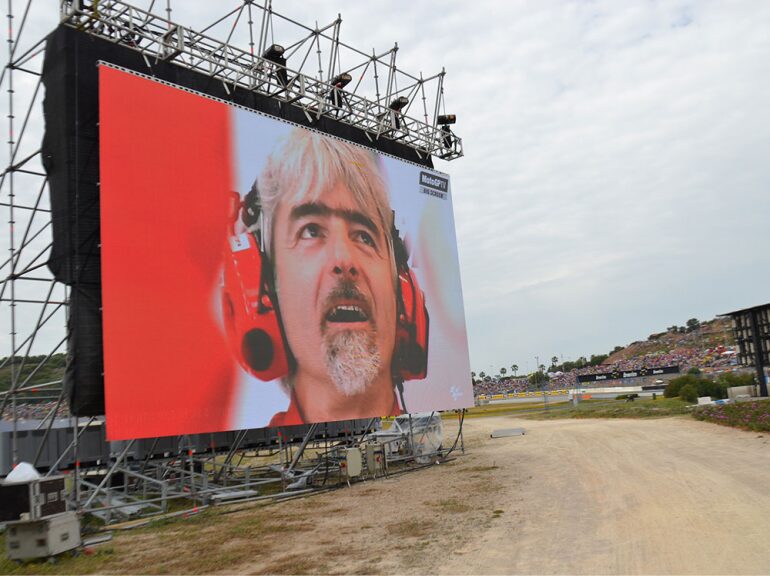
Noleggio display LED
Maintaining Daylight Visibility Through Better Pixel Pitch Configuration
Optimal pixel pitch reduces long-term maintenance costs because it protects the system from brightness stress. When pitch matches the environment, the display does not require unnecessary luminosity. This lowers heat, reduces LED degradation, and slows color drift.
Inoltre, correct pitch selection protects structural components from thermal expansion. Outdoor screens face daily temperature shifts, and modules must remain stable despite constant expansion and contraction. Balanced configurations reduce mechanical stress on PCB boards, solder points, and cabinet frames.
Così, pixel pitch selection supports not only optical performance but also mechanical reliability.
Conclusione: Pixel Pitch as the Foundation of Daylight Readability
Pixel pitch shapes the clarity, luminosità, efficienza, E overall visual experience of outdoor LED screens. It also influences contrast, color accuracy, and long-term operational stability. As daylight-visible LED displays become essential for advertising, sports venues, snodi dei trasporti, and public installations, pixel pitch selection has become a strategic decision.
Buyers who understand these principles build displays that perform well under sunlight, support high-quality content, and deliver lasting value. Aligning pitch, luminosità, and modular architecture ensures that outdoor LED screens remain readable, durevole, and visually compelling in every lighting condition.
