


Вы рассматриваете возможность установки прозрачного светодиодного экрана на витрину вашего магазина?, но беспокойтесь, что продукт с 90% transmittance may show a grainy image up close and leave your customers unable to see your ads clearly? Or perhaps, after customizing a transparent screen for an office building curtain wall, you found the weight exceeded the limit and the glass couldn’t bear it—forcing a costly rework. Maybe your museum exhibit requires virtual/real integration, but you still can’t tell the difference between P2.5 and P3 displays, nor whether front or rear maintenance is more suitable…

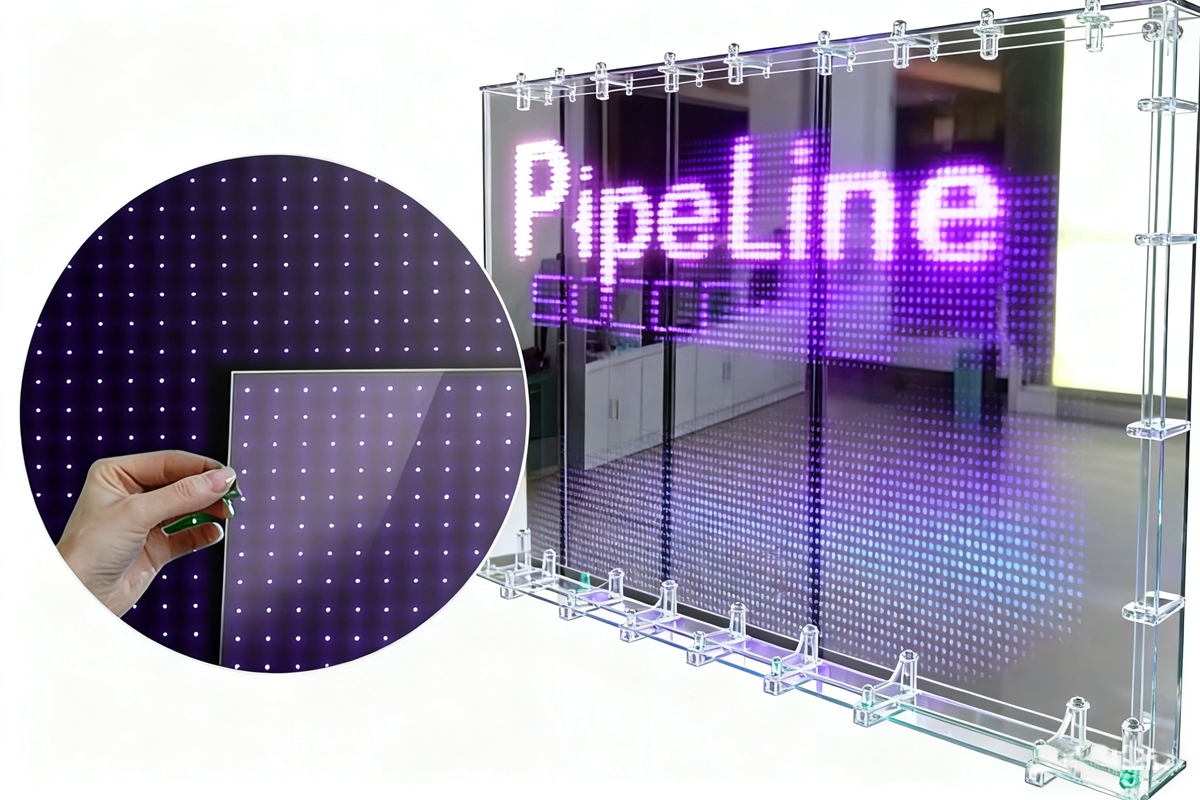
Transparent LED display
If you’ve faced any of these issues during transparent LED procurement, you’re not alone. Today’s commercial displays demand “transparency without obstruction,” building facades want to “disappear by day and glow by night,” and creative spaces need “flexible adaptation for complex structures.” Transparent LED screens have become essential, but with a market full of varied specs and products—even experienced buyers get stuck with “confusing parameters,” “scene mismatches,” or “budget overruns.” Choose high transmittance and risk blurry images; opt for small pixel pitch and face complicated installation; pick outdoor models but struggle with future maintenance. In the end, it’s all about compromise or redesign, leading to delays and wasted resources.
As an engineer and installation consultant with more than ten years in the LED display industry, I’ve seen countless cases where poor screen selection led to wasted investment. Retail stores with screens too dim for sunlight, hotel lobbies ruined by thick displays, outdoor buildings plagued by water damage due to poor encapsulation choices. The following guide draws on these real-life pitfalls and over a thousand successful projects, breaking down the core specs, product types, and application scenarios for transparent LED screens—so you can avoid selection traps and find the best solution for your needs.

5.0mm Ultra-Thin,Boundless Vision
As Transparent as Glass,Автономный &Space-Saving
1. What Is a Transparent LED Display? Definition and Market Trends
А transparent LED display is a display device based on Micro LED or Mini LED technology, engineered for high transmittance via special structure design. It achieves “high brightness and contrast” while using sparse arrangements or transparent substrates, so the display presents digital content without blocking the real-world background—enabling both visibility and display.
The market growth rate for transparent LED screens now exceeds 35% ежегодно, making it one of the fastest-growing subfields in the LED industry. The reasons: commercial venues now require “immersive experience,” architecture calls for “intelligent curtain walls,” and creative industries explore “flexible display carriers.” Compared with traditional LED screens, transparent LED screens cut installation costs by over 40%, power consumption drops to 60% of conventional screens, and mesh with energy-saving/green development goals. As 5G+8K, smart interactivity, and IoT advance, the application boundary will only expand.

Transparent display with excellent heat dissipation
2. Key Technical Specifications: Your Selection Essentials
Technical specs directly determine display performance, installation difficulty, and total cost. Focus on these critical parameters when buying:
Transmittance (Transmittance)
-
The proportion of light passing through the screen, shown as percentage (mainstream products: 60%-95%).
-
Higher transmittance = less obstruction of background.
-
Advice: Store windows & boutiques (need display + daylight), выбирать 85%+; curtain walls/interior partitions (less daylight requirement), 60%-80% is fine for higher pixel density.
-
Important: Higher transmittance often means lower pixel density—you must balance according to viewing distance.
-

Прозрачный дисплей настраиваемого размера
Пиксельный шаг & Разрешение
-
Пиксельный шаг (P2.5, P3, П.4, P5, P8…) relates to LED spacing.
-
Resolution = screen size ÷ pixel pitch.
-
Advice: Viewing distance of 1-3m (окна, small exhibits)—pick P2.5-P4 for clarity; ≥5m (façade/stages)—use P5-P8 for cost-effectiveness.
-
Trend: Mini LED enables P1.8-P2.0, fit for ultra-high precision.
-

Transparent LED display

Screen Thickness & Масса
-
Main advantage: thin & легкий вес (5-30толщина мм, 8-15кг/м²), versus traditional screens (50-100мм, 25-40кг/м²).
-
Advice: Glass installations ≤15mm, ≤12kg/m² allow direct mounting; indoor creative spaces prefer flexible screens (5-8мм, ≤8kg/m²).
-
Install impact: Thin products can use magnetic/suspended installs, cutting time/cost.
Яркость & Обновление частоты

Customisable-sized transparent LED display
-
Brightness determines outdoor/bright environment clarity (1500-5000CD / M²); refresh rate in Hz (main products: ≥3840 Гц).
-
Advice: на открытом воздухе, choose ≥3000cd/m²; indoors, 1500-2500cd/m² is fine. For livestream or dynamic video, ≥5000Hz to avoid flicker.
-
Примечание: High brightness means higher energy use; indoor scenes don’t need max brightness.
Угол просмотра & Color Performance
-
Horizontal viewing angle usually 120°-160°, vertical 110°-150°. Color gamut NTSC 85%+.
-
Advice: Multi-angle viewing (торговые центры, atrium) needs ≥150° angles; color-critical (flagship stores, exhibits) require NTSC ≥90%.
Система управления & Signal Interface
-
Control system is the display’s “brain”—affects manageability and stability; interface determines compatibility.
-
Advice: Prefer systems with remote control, area management, scheduled switch—ideal for chains or multi-zone. High-end sites choose 4K decoding and multi-screen linkage.
-
Интерфейс: HDMI, DVI, USB, RJ45, ensure they match your players/cameras; outdoor projects should support 5G/WiFi for minimal wiring.
Maintenance Method (Спереди/сзади, Module Replacement)
-
Maintenance style affects long-term costs.
-
Передний: Modules can be serviced from the front; no rear access needed—good for windows/glass walls.
-
Rear: Requires ≥30-50cm behind the screen; suitable for large standalone screens, often cheaper.
-
Advice: Glass or no rear access = front-maintenance; open indoor = rear, for value.
3. Main Product Types & Structural Trends
| Тип | Функции & Использовать |
|---|---|
| Film Type | 5-8толщина мм; attaches to glass; 90%+ пропускание; ideal for shops/windows, but limited pixel density. |
| Glass Type | LED on glass substrate; 10-15толщина мм, 80%-90% пропускание; combines effect & стабильность; for facades, galleries. |
| Flexible Type | Flexible PCB, can bend/cut; 5-10толщина мм, ≤8kg/m²; fits curved/special shapes, creative installations. |
| Grid/Strip Type | Grid structure; 60%-85% пропускание, high pixel density/clarity; fits outdoor facades, large stages. |
New Encapsulation Tech:
-
Гоб (Glue on Board): LED sealed on PCB with glue; up to IP67, waterproof/dustproof, ideal outdoors, extends life by 30%.
-
COB (Chip on Board): Chip mounts direct on PCB, no pins; higher density, more detail, shock resistance—ideal for luxury interiors.
4. Сценарии применения & Лучшие практики
1. Commercial Storefronts & Розничная торговля
-
Select high transmittance (≥85%) lightweight displays for display visible through glass.
-
Тематическое исследование: Luxury cosmetic store uses P3 (90% пропускание). Dynamic ads, natural light, interactive touch boosts sales.
2. Architectural Curtain Walls
-
Need weather resistance and brightness (≥3000cd/m²), GOB encapsulated grid, rear-maintenance; pixel pitch by distance (P5-P8).
-
Case: Landmark building, P6 grid, 5000м², 75% пропускание. Invisible by day, media at night; IP67 fights rain/wind, 8-year life.
3. Музеи / Art Spaces / Auto Shows
-
Focus on color accuracy/detail (П2,5-П4, NTSC ≥90%), dynamic + real merging.
-
Case: Auto museum, P3 flexible screen wraps cars, showing design history over real cars—multi-screen sync, immersive lighting.
4. Interior Partition & Decor
-
Thin/light glass/flexible products customized for offices, отели, торговые центры.
-
Case: Hotel lobby, П.4 (88% пропускание), stylish divider playing scenic videos.
5. Stage / Event Creative Use
-
Choose flexible/modular types for quick install/removal, customizable shapes, integrate with lights/sound.
-
Case: Concert with floating 8mm flexible screens for curved 3D visuals; wireless fast content swap.
5. Procurement Recommendations: Scene-Based Selection
| Приложение | Recommended Type | Core Specs | Installation Method |
|---|---|---|---|
| Retail Windows | Film/Glass | ≥85% transmittance, P3-P4, ≥2000cd/m² | Glass adhesive/hanging |
| Curtain Walls | Grid (Гоб) | 60-80%, P5-P8, ≥3000cd/m² | Frame mounting |
| Museums/Art | Glass (COB) | 80-90%, P2.5-P3, wide gamut | Embedded/hanging |
| Interior Partition | Flexible/Glass | ≥85%, P4-P5, ≤15mm thick | Ground/hanging |
| Stage/Events | Flexible/modular | 75-85%, P4-P6, легкий вес | Fast-join/hanging |
Parameter Selection Tips:
-
Want transparency? Sacrifice pixel density, pick high-transmittance.
-
Want sharp visuals? Pick small pitch, high refresh, wide color.
-
Limited space? Go thin/front-maintenance.
-
на открытом воздухе? Prioritize brightness, IP65+/GOB sealed.

 Transparent LED lamp beads
Vendor & Service Considerations:
-
Choose brands with proven technology, robust manufacturing, and case history—avoid unreliable budget sellers.
-
Service matters: Check for tailored solution design, installation expertise, гарантия (2-3 years standard), and prompt spare parts/maintenance.
6. Transparent LED vs. Traditional Display Technologies
| Аспект | Transparent LED | Traditional LED | LCD |
|---|---|---|---|
| Visual Effect | High transmittance, blends with real scene | Opaque, standalone display | Semi-transparent, average effect |
| Energy Use | Низкий (100-200W/㎡) | Высокий (300-500W/㎡) | Середина (150-300W/㎡) |
| Aesthetics | Thin, свет, customizable | Thick, fixed shape | Medium thickness/moderate flexibility |
| Масштабируемость | Supports splice/cut, fits irregular shapes | Limited splice, needs steel support | Black edge, limited flexibility |
| Install Cost | Низкий (no complex steel required) | Высокий (extra steel for support) | Середина (needs rack) |
| Стоимость обслуживания | Низкий (передний, module replaceable) | Высокий (rear, reserve access) | Середина (reserve access needed) |
Краткое содержание:
Choosing a transparent LED display requires weighing transmittance, Пиксельный шаг, яркость, control, and maintenance options—considering your space and project demands. Reference scene-matched specs and technology solutions for the optimal configuration.
