


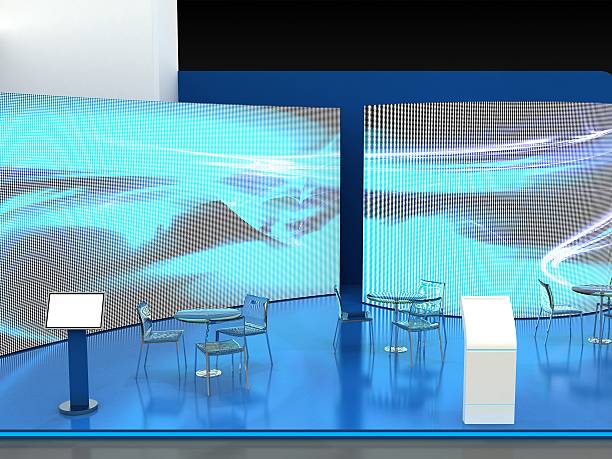
Designing a showroom requires a perfect balance of light and space. Jedoch, many buyers feel lost when choosing pixel pitches. Should you buy a P2, a P1.5, or a P1.2 screen? If the resolution is too low, the image looks grainy. Umgekehrt, if the pitch is too fine, you overspend your budget. This guide helps you navigate the technical world of showroom LED display screens. We provide the clarity you need to make a confident decision.
1. The Viewing Distance Formula: Math Meets Vision
Der “P” in LED screens stands for pixel pitch. It measures the distance between the centers of two pixels. daher, a smaller number means a higher pixel density.
A simple formula exists for the best viewing experience. You multiply the pixel pitch by 1,000 to find the minimum distance. Zum Beispiel, a P2 screen looks best from 2 Meter entfernt. If you stand closer, you will see individual dots. Folglich, Die “sweet spot” is where the dots merge into a smooth image. This calculation ensures your visuals remain crisp and professional.
2. Scenario Recommendations: Matching Space to Pitch
Entrance Hall (3–5 Meters Viewing) → P2 / P2.5
At the entrance, your showroom LED display screens act as a welcome. Guests usually stand several meters back to see the whole wall. daher, a P2 or P2.5 pitch is ideal for this area. It offers high impact at a very reasonable cost. You gain a massive, bright canvas without unnecessary overspending.
Product Showcase Area (1–2 Meters Viewing) → P1.5 / P1.2
In specialized display zones, visitors walk much closer to the wall. They want to see fine details of your products or text. Folglich, you need a P1.5 or P1.2 high-resolution screen. These pitches provide a “retina” experience at a close range. The image remains smooth and lifelike even as people approach.
Interactive Touch Zones (0.5 Meters Viewing) → P0.9 / P0.7
Touch-screen interactions require the highest possible density. Users stand at arm’s length from the showroom LED display screens. daher, you should consider ultra-fine pitches like P0.9 or P0.7. These models use COB technology for a smooth, glass-like touch surface. They deliver incredible detail for maps, data, or 3D models.
3. Balancing Your Budget with Visual Quality
Choosing the finest pitch is tempting but often unnecessary. The cost of LED panels increases sharply as the pitch shrinks. Zum Beispiel, a P1.2 wall costs significantly more than a P2.
Erste, measure the exact walking paths in your showroom. Then, identify where people will spend the most time. If people stay 3 Meter entfernt, P1.2 is a waste of money. You can use those savings to buy a larger P2 screen instead. Always prioritize the actual human experience over the highest specification.
4. The Importance of Color and Contrast
Pixel pitch is only one part of the quality equation. You must also consider color depth and refresh rates. Hochwertig showroom LED display screens feature 16-bit grayscale. This ensures smooth gradients without “banding” in dark scenes.
Außerdem, a high refresh rate prevents flickering on camera phones. Visitors will likely take photos of your beautiful showroom. daher, your screen must look perfect through a lens. Ensure your choice includes high-contrast chips for deep, rich blacks. This brings your digital content to life with vivid realism.
Abschluss: Planning Your Perfect Showroom Vision
Selecting the right screen pitch transforms a room into an experience. By understanding distances, you avoid graininess and save your budget. Match the technology to the way people move through your space.
Start by mapping your guest’s journey today. Then, pick the pitch that fits their eyes and your goals. Professional showroom LED display screens build trust through visual excellence. Take the time to choose the right “P” for your project. Your showroom deserves a display that shines with absolute clarity.
